Nvidia Takes a Bold Step in AIDriven Chip Design
A deep dive into Nvidias $2 billion investment in Synopsys and the implications of their multi-year partnership for AI-accelerated semiconductor design.

Overview
Nvidia has taken a major stride in shaping the future of semiconductor design by investing US $2 billion in Synopsys common stock, as part of a renewed multi‑year partnership to integrate accelerated computing, AI, and simulation tools into chip design workflows.
The deal gives Nvidia roughly a 2.6% stake in Synopsys, buying shares at US $414.79 per share, aiming to combine Nvidia’s computing power with Synopsys’ EDA and simulation software to speed up design, verification, and validation for semiconductors and complex engineering systems.
Why This Matters
- Bridging hardware + design software: Aligns GPU‑accelerated computing with EDA tools to dramatically cut simulation and verification cycles.
- Accelerated innovation across industries: Benefits sectors like electronics, robotics, aerospace, automotive, and digital twin simulations.
- AI‑driven “EDA 2.0”: Combines AI-capable Nvidia stack with Synopsys’ design software for more automated, scalable, and efficient chip design.
- Ecosystem consolidation: Nvidia deepens influence over semiconductor design and simulation workflows, enhancing long-term adoption.
Key Features & Strategy of the Partnership
1. GPU‑Accelerated EDA & Engineering Workflows
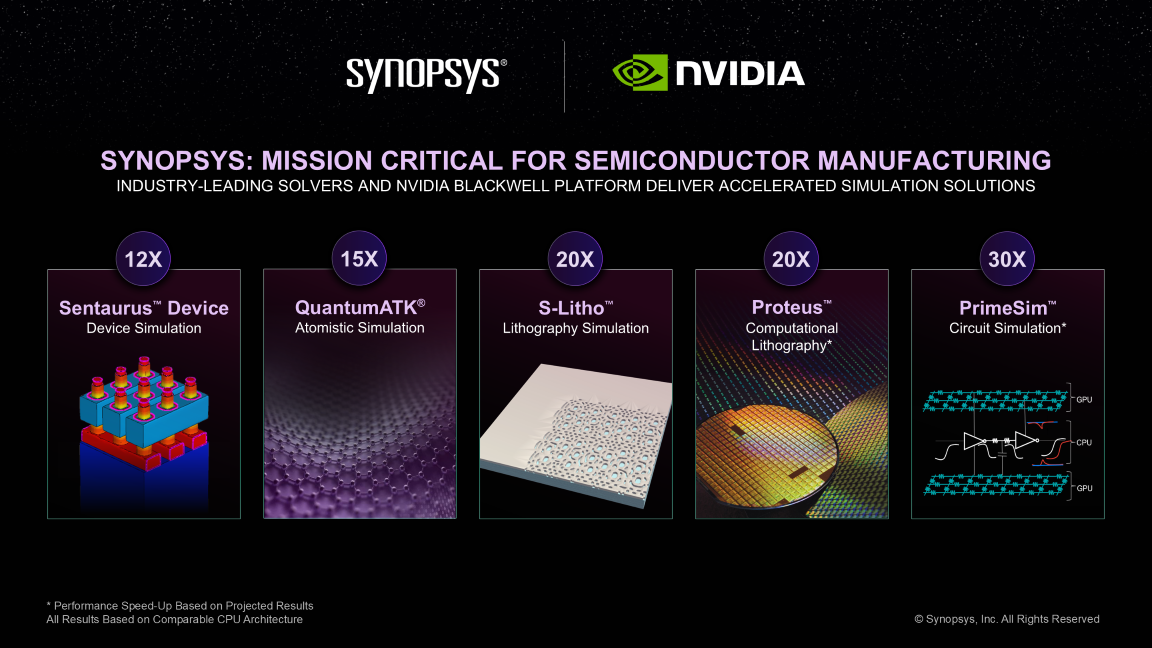
Synopsys tools will leverage Nvidia’s CUDA‑X libraries, enabling compute-intensive tasks like verification, simulation, and electromagnetic analysis to run on GPUs, drastically improving speed and scalability.

2. AI & Digital Twin Design Tools
Integration of AI-driven workflows and digital twin capabilities could transform chip and system design, allowing engineers to validate complex systems in virtual environments before physical prototyping.
3. Cloud-Ready Engineering Solutions
The partnership aims to make GPU-accelerated EDA and simulation accessible via the cloud, broadening availability for startups, small teams, and distributed engineering groups.
4. Strategic Capital Alignment
Nvidia’s stake aligns incentives, ensures tighter cooperation, and potentially influences EDA tool development, embedding Nvidia deeper into the semiconductor design ecosystem.
Implications for Developers, Engineers, and the Semiconductor Industry
- Faster time-to-market: Shorter verification and simulation cycles enable rapid prototyping.
- More powerful AI-enabled design tools: Engineers can perform high-fidelity simulations at scale.
- Democratization of advanced design workflows: Cloud access lowers barriers for smaller teams.
- Greater ecosystem dependence: Potential vendor lock-in with Nvidia-optimized flows.
- Acceleration of AI-hardware co-design: Enables next-gen AI accelerators, SoCs, and embedded systems.
What We Know and What’s Still TBD
| Known | TBD |
|---|---|
| Nvidia invested US 414.79/share (~2.6% stake) | Timeline for full GPU-accelerated EDA deployment |
| Multi-year strategic partnership integrating Nvidia compute and AI with Synopsys tools | Cloud pricing, licensing, and accessibility for smaller firms |
| Plans for digital-twin simulations, GPU-accelerated verification, and cloud access | Real-world adoption rates across chipmakers and startups |
| Non-exclusive deal; Synopsys continues work with other firms | Potential competitive response from other EDA providers |

Conclusion
The Nvidia–Synopsys deal marks a shift from “AI for models” to “AI for engineering infrastructure.” By combining Nvidia’s GPU and AI power with Synopsys’ EDA expertise, this partnership could reshape how chips and complex systems are designed, simulated, and validated - lowering barriers, speeding up development, and enabling more ambitious hardware and system designs.
For developers, engineers, and innovators building AI accelerators, robotics, SoCs, and embedded systems, this signals the start of an era where AI is not just the application, but the tool that builds the application.
